
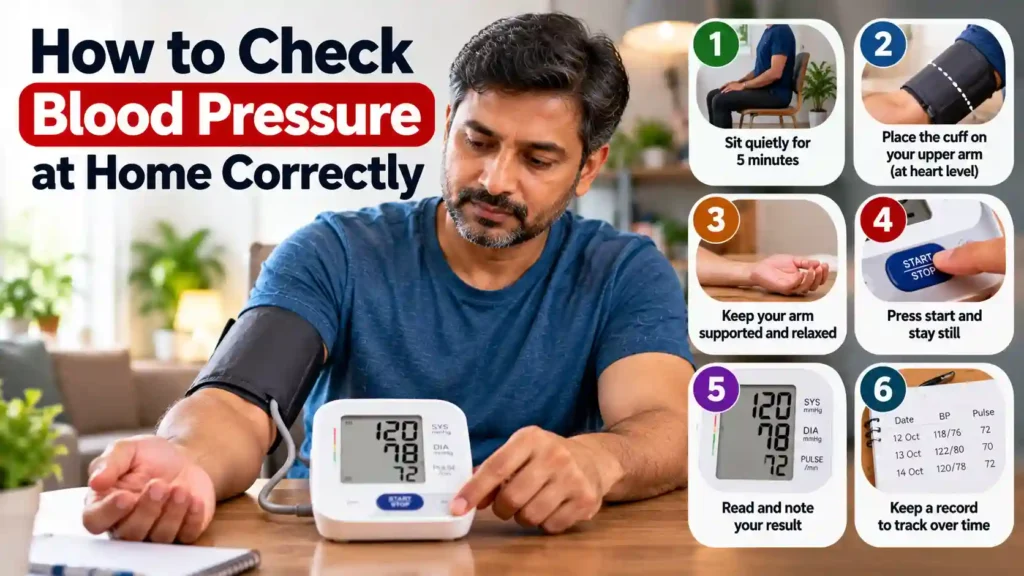
How to Check Blood Pressure at Home Correctly
A blood pressure reading in the clinic is only a snapshot. Many people have higher readings in the
doctor’s office because of anxiety, called white-coat hypertension, while others have normal clinic
readings but high pressure at home, called masked hypertension. Home monitoring gives a more
accurate picture and helps your doctor fine-tune treatment. But the readings are only useful if they are
taken correctly.
Choosing a Monitor
- Choose an automatic upper-arm monitor. Wrist and finger devices are generally less reliable.
- Pick a device validated for accuracy by an independent body.
- Use the right cuff size, since a cuff that is too small gives falsely high readings.
- Take the monitor to your clinic once, to compare it with the doctor’s device.
- Replace batteries regularly and follow the manufacturer’s care instructions.
Before You Measure
- Avoid caffeine, smoking, and exercise for at least thirty minutes.
- Empty your bladder, since a full bladder can raise the reading.
- Sit quietly for five minutes in a calm environment.
- Do not talk or use your phone during the measurement.
Correct Technique
- Sit in a chair with your back supported and your feet flat on the floor, legs uncrossed.
- Rest your bare upper arm on a table, so that the cuff is at heart level.
- Place the cuff on bare skin, not over clothing, about two centimetres above the elbow.
- Press the start button and stay still.
- Take two readings one minute apart, and record both.
When and How Often
For a proper home assessment, measure in the morning, before taking medicines and before breakfast,
and again in the evening. Do this for seven days, and ignore the first day’s readings. Average the rest.
Once your blood pressure is controlled, a few readings a week or a short monitoring period before each
visit is usually enough, as your doctor advises.
How to Interpret Home Readings
A home average of about 135/85 mmHg or higher is generally considered high, and many guidelines
use a lower threshold of 130/80 for people with diabetes, kidney disease, or heart disease. Normal is
below about 120/80. Your doctor will set your target. A single high reading does not mean hypertension,
but a pattern does.
Keep a Log
Record the date, time, readings, medicines taken, and anything unusual such as stress, poor sleep, or
illness. Bring the log, or the monitor with its memory, to your appointment. Patterns help your doctor
decide whether to adjust treatment.
Common Mistakes
- Measuring just after walking, eating, or drinking tea.
- Talking, crossing legs, or holding the arm unsupported.
- Using a cuff that is too small or too large.
- Measuring over clothes.
- Checking too many times in a row, which causes anxiety and fluctuating readings.
- Changing medicines on your own based on a single reading.
When to Seek Help
Seek emergency care if your reading is 180/120 mmHg or higher with chest pain, breathlessness,
severe headache, weakness, trouble speaking, or vision changes. If your reading is very high without
symptoms, rest for a few minutes and recheck, and call your doctor if it remains high. Also seek advice if
you feel dizzy or faint with low readings, or if you have a very slow or irregular pulse.
Lifestyle to Support Home Readings
Reduce salt, stay active, maintain a healthy weight, limit alcohol, avoid tobacco, sleep well, and manage
stress. These measures lower blood pressure and make medicines work better.
Care at Dr. Rajender’s Lifestyle Clinic
The clinic manages hypertension alongside Type 2 diabetes, thyroid disorders, PCOS, obesity, and
metabolic conditions, using a structured, evidence-based approach with personalised nutrition, physical
activity, lifestyle correction, and continuous medical guidance.
Book a Consultation
Visit https://www.drrajenderslifestyleclinic.com/ to learn more and book a consultation.
Frequently Asked Questions
Which arm should I use to measure blood pressure?
Use the arm with the higher readings if there is a consistent difference, as your doctor advises, and use
the same arm each time.
Is a wrist BP monitor accurate?
Wrist monitors are more sensitive to position and are generally less reliable than upper-arm devices.
Should I measure BP before or after taking my medicines?
For monitoring control, many doctors advise measuring before the morning tablet. Follow your doctor’s
advice.
Why is my BP higher at the clinic?
Anxiety in the clinic can raise readings, a phenomenon called white-coat hypertension. Home
monitoring helps clarify this.
Read Also:

One Response