
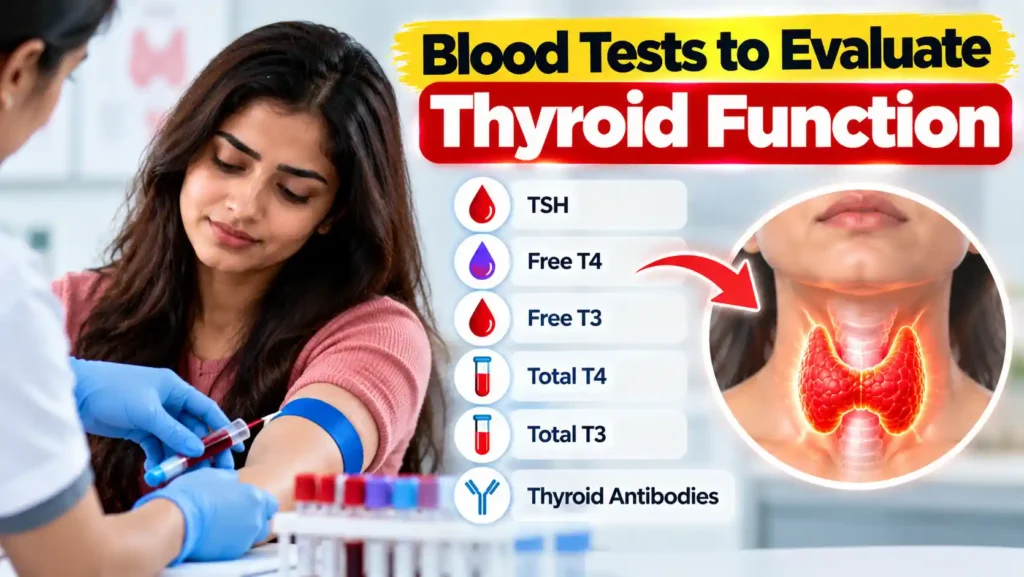
Blood Tests to Evaluate Thyroid Function: Thyroid disorders can affect energy levels, body weight, heart rate, digestion, menstrual cycles, and overall metabolism. Because these symptoms can also occur with other medical conditions, blood tests are often an important part of evaluating thyroid function.
The most commonly used initial test is thyroid-stimulating hormone (TSH). Depending on the result and the person’s symptoms, a healthcare professional may also recommend free thyroxine (free T4), triiodothyronine (T3), or thyroid antibody tests.
No single thyroid blood test provides every piece of information. The right combination depends on your symptoms, medical history, medications, pregnancy status, and the reason for testing.
1. TSH Test: A Common First Step
TSH is produced by the pituitary gland and signals the thyroid to produce thyroid hormones.
In many people with primary thyroid disorders:
- High TSH may indicate an underactive thyroid.
- Low TSH may indicate excessive thyroid hormone activity.
- TSH within the reference range often suggests normal thyroid regulation, although exceptions exist.
TSH is generally the first test used to assess suspected primary thyroid dysfunction. However, it may not be sufficient on its own if a pituitary disorder is suspected or if other clinical circumstances affect the result.
2. Free T4 Test
T4, or thyroxine, is the main hormone released by the thyroid gland. Much of it circulates attached to proteins, while a small amount remains unbound.
Free T4 measures this unbound fraction.
It is useful for:
- Confirming suspected hypothyroidism.
- Assessing possible hyperthyroidism.
- Interpreting an abnormal TSH result.
- Monitoring selected thyroid conditions and treatment plans.
For example, a high TSH with a low free T4 commonly indicates overt primary hypothyroidism. A high TSH with normal free T4 may indicate subclinical hypothyroidism.
3. T3 Test
T3, or triiodothyronine, is an active thyroid hormone. T3 testing can be particularly useful when hyperthyroidism is suspected.
Some people with hyperthyroidism have elevated T3 even when free T4 is within the reference range. In these cases, a T3 test may help clarify the diagnosis.
T3 is generally less useful than TSH and free T4 for diagnosing routine hypothyroidism, so it is not necessary for everyone.
4. Thyroid Antibody Tests
Thyroid antibodies can help identify autoimmune thyroid conditions.
Common tests include:
- Thyroid peroxidase antibodies (TPOAb): Often associated with Hashimoto’s thyroiditis and sometimes found in other autoimmune thyroid conditions.
- Thyroglobulin antibodies (TgAb): May support the assessment of autoimmune thyroid disease in selected situations.
- TSH receptor antibodies (TRAb): Can help assess Graves’ disease, a common cause of hyperthyroidism.
A positive antibody result does not automatically mean that medication is required. Treatment decisions depend on thyroid function, symptoms, pregnancy considerations, and other clinical factors.
5. Are Other Tests Sometimes Needed?
Yes. Additional tests or investigations may be recommended depending on the findings.
For example:
- A thyroid ultrasound may be used to evaluate a thyroid nodule, goitre, or structural abnormality.
- Further pituitary hormone testing may be considered if a central thyroid disorder is suspected.
- Repeat blood testing may be appropriate if the initial result is mildly abnormal or could be affected by illness or medication.
Ultrasound does not measure thyroid hormone levels; it evaluates the structure of the gland.
How Should You Prepare for Thyroid Blood Tests?
Follow the instructions provided by your laboratory or healthcare professional.
- Fasting is not usually required for TSH, free T4, or T3 alone, although other tests collected at the same time may require fasting.
- Tell your clinician about all medicines and supplements you take.
- Biotin, often found in hair and nail supplements, can interfere with some thyroid laboratory tests. Ask whether you need to pause it before testing and for how long.
- If you take levothyroxine, ask whether your blood test should be taken before or after your usual dose so that monitoring is consistent.
- Tell your healthcare professional if you are pregnant or planning pregnancy, because interpretation and treatment targets may differ.
Do not stop prescribed medication solely to prepare for a blood test unless instructed to do so.
Frequently Asked Questions
1. Which thyroid test should I take first?
TSH is commonly the first test for suspected primary thyroid dysfunction. Free T4 and other tests may be added according to your results and medical history.
2. Can a TSH test alone diagnose every thyroid problem?
No. TSH is useful, but free T4, T3, antibody testing, or further assessment may be needed in certain circumstances.
3. Do I need to fast before a thyroid test?
Fasting is generally not necessary for routine thyroid function tests alone. Follow the instructions given for your particular blood test appointment.
4. What does a high TSH with normal free T4 mean?
It may indicate subclinical hypothyroidism. The need for treatment depends on the degree and persistence of the abnormality and other clinical factors.
5. How often should thyroid function be checked?
It depends on whether you have symptoms, a diagnosed thyroid condition, medication changes, pregnancy, or other risk factors. Your clinician can recommend the appropriate schedule.
Conclusion
TSH, free T4, T3, and thyroid antibody tests provide different information about thyroid function and possible underlying causes. The appropriate tests depend on your symptoms and clinical circumstances, and results should be interpreted together rather than in isolation.
Need guidance about thyroid testing?
Dr. Rajender’s Lifestyle Clinic in Banjara Hills, Hyderabad, provides medical guidance for thyroid disorders and metabolic health. Book a consultation to discuss your symptoms, understand your test results, and determine which investigations may be appropriate.
Read Also:

One Response